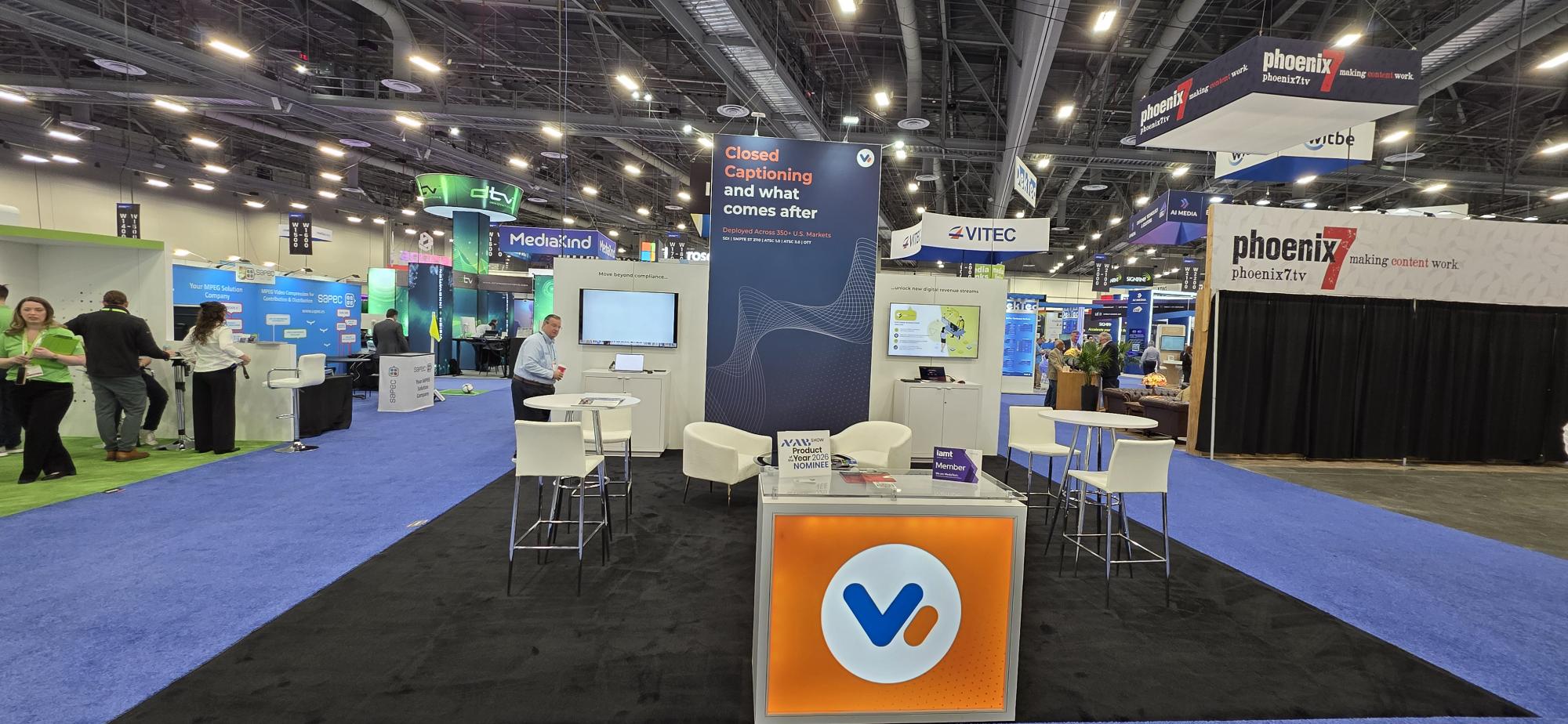
Event recap
NAB Show Las Vegas
NAB Show 2026: Operational AI Moves Into Production
NAB Show 2026 demonstrated how artificial intelligence is transitioning from experimentation to operational deployment across the broadcast industry. While AI remains one of the most discussed topics in media technology, broadcasters are increasingly focused on practical applications that improve efficiency, support editorial workflows, and reduce operational complexity. Conversations throughout the event highlighted a growing demand for AI systems capable of delivering measurable value in production environments rather than standalone demonstrations.

By
VoiceInteraction Team
EVENT INFORMATION
Event
Location
Industry
Date
TOPICS COVERED
FROM THE EVENT
Overview
NAB Show 2026 brought together broadcasters, media organizations, technology providers, and content creators from across North America and international markets to explore the technologies shaping the future of media.
Artificial intelligence remained a dominant topic throughout the exhibition, but the nature of the conversation has evolved considerably. Broadcasters are moving beyond experimentation and evaluating how AI can be integrated into everyday operations without compromising reliability, editorial oversight, or workflow efficiency.
Across the show floor, discussions increasingly focused on operational AI—the practical application of AI technologies to support production, accessibility, content management, monitoring, and digital publishing workflows.
For VoiceInteraction, many conversations reflected a growing recognition that speech technologies represent one of the most mature and immediately deployable forms of operational AI. By transforming spoken content into structured information, organizations can automate repetitive tasks, accelerate content workflows, and improve access to valuable information already embedded within their media assets.
Key themes
AI Is Moving Beyond Proofs of Concept
The industry conversation has shifted from experimentation toward implementation.
Broadcasters are increasingly evaluating technologies based on operational impact rather than novelty. Organizations want solutions that integrate with existing workflows, reduce manual effort, and provide measurable improvements in efficiency and content management.
The question is no longer whether AI can support media operations, but where it can deliver the greatest operational value.
Speech Technologies Lead Practical AI Adoption
Among the many AI technologies discussed at NAB Show, speech recognition continues to stand out as one of the most established and deployable solutions.
Speech technologies already support captioning, transcription, monitoring, metadata generation, archive search, and content intelligence workflows. Because every broadcast contains spoken information, speech processing offers a practical foundation for broader AI-driven automation initiatives.
Many organizations are beginning their operational AI journey through speech-enabled workflows that provide immediate benefits while remaining easy to integrate into existing environments.
Automation Is Expanding Across Media Workflows
Broadcasters continue to face pressure to produce more content across more platforms with limited resources.
As a result, automation remains a major focus. AI technologies are increasingly supporting tasks such as:
Transcription
Captioning
Metadata generation
Content classification
Monitoring
Clipping
Publishing preparation
Rather than replacing editorial teams, these technologies help reduce repetitive work and allow staff to focus on higher-value activities.
Operational Reliability Matters More Than AI Hype
One of the strongest themes at NAB Show 2026 was the growing emphasis on reliability.
Broadcasters operate environments where downtime, delays, and workflow interruptions have immediate consequences. As AI technologies move into production environments, organizations are prioritizing solutions that demonstrate operational resilience, transparency, scalability, and long-term support.
This shift reflects the industry's increasing maturity in evaluating AI technologies.
Accessibility Continues to Drive Innovation
Accessibility remains a critical operational and regulatory requirement.
At the same time, organizations are discovering that accessibility workflows can generate broader operational value. Captioning and transcription systems increasingly serve as sources of metadata, content intelligence, archive search capabilities, and multilingual distribution opportunities.
As a result, accessibility technologies are becoming more deeply integrated into broader content operations strategies.
Looking ahead
NAB Show 2026 reinforced a clear industry trend: operational AI is becoming part of everyday broadcast infrastructure.
Broadcasters are increasingly focused on technologies that improve efficiency, enhance content workflows, and support the growing complexity of multi-platform media operations. The most successful AI deployments are those that solve practical challenges rather than simply demonstrating technical capabilities.
Speech technologies are particularly well positioned within this transition. By transforming spoken content into structured, searchable, and actionable information, they provide a foundation for automation, accessibility, monitoring, and content intelligence initiatives.
For VoiceInteraction, NAB Show 2026 confirmed that the future of AI in broadcasting will be defined not by isolated tools, but by integrated systems that support real operational needs. As broadcasters continue modernizing their workflows, operational AI will play an increasingly important role in helping organizations work faster, smarter, and more efficiently.
← Back to all events
CONTINUE READING
Related event insights
Explore more observations and takeaways from the events VoiceInteraction attends.



Turn event conversations into practical workflows
Speak with our team about the requirements, deployment context, and speech technology workflows behind this insight.